Most construction companies trust QuickBooks to tell them the financial truth. That is reasonable. QuickBooks is good at accounting.
The problem is that project margin usually starts drifting long before accounting sees it.
A superintendent approves work in the field. A project manager talks through a scope change with the owner. A selection comes in over allowance. A subcontractor sends a revised number. A draw gets prepared from yesterday's budget instead of today's reality. None of those moments are accounting events yet, but every one of them can change the job's outcome.
That is where builders get exposed.
QuickBooks is not the problem
The wrong conclusion is that builders need to replace QuickBooks.
They usually do not.
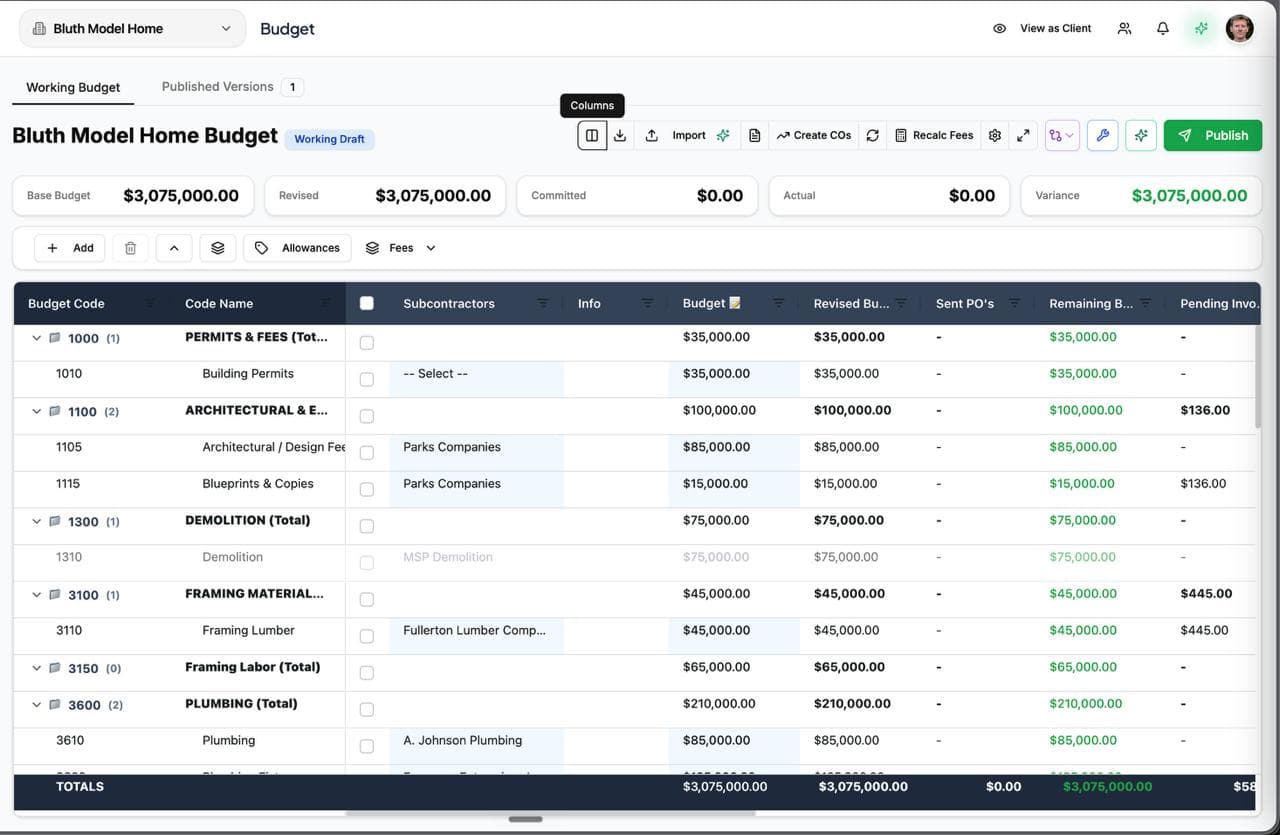
QuickBooks is where the books should stay clean. The issue is everything that happens before the transaction becomes clean enough for accounting: budgets, change orders, purchase orders, selections, invoices, draws, lien waivers, field updates, and owner approvals.
That operating layer is where the business either protects margin or slowly gives it away.
The dangerous gap
The gap usually looks harmless at first.
A spreadsheet tracks the working budget. Email tracks owner decisions. Texts track field changes. Photos sit on phones. A project manager keeps the real story in their head. Accounting waits for something clean enough to enter.
That can work for a few jobs.
Then volume increases. Jobs overlap. Clients expect faster answers. Subs revise pricing. Draws need backup. Owners ask why something changed. Suddenly the company is depending on memory, inbox archaeology, and spreadsheet discipline to protect margin.
That is not a system. That is a risk.
What better control looks like
A builder operating system should not fight QuickBooks. It should feed it better information.
That means:
- Budget updates are tied to the job record.
- Change orders are connected to owner approvals.
- Purchase orders and invoices reconcile against current scope.
- Draws reflect the latest project truth.
- Lien waivers are part of the payment workflow, not a last-minute scramble.
- Field photos, documents, selections, and communication stay attached to the work they affect.
The goal is not more software. The goal is fewer places for margin to leak unnoticed.
Where AI actually helps
AI is useful in construction when it reduces the administrative drag around real workflows.
It can summarize owner communication. It can flag missing approvals. It can help prepare change order language. It can surface job-cost anomalies. It can make documents and photos searchable. It can help teams find the thing they know exists but cannot locate quickly.
But AI should not bypass judgment. It should not invent facts. It should not send commitments without approval.
For builders, the right AI posture is practical: help the team see the risk earlier, prepare the work faster, and keep humans in control.
The BuildTools thesis
BuildTools is built around a simple idea: custom builders and remodelers do not need enterprise software bloat, and they do not need another disconnected app.
They need a construction operating system that keeps project operations connected to financial reality.
QuickBooks can remain the accounting backbone. BuildTools becomes the operating layer around it — budgets, change orders, selections, schedules, documents, photos, invoices, draws, lien waivers, and AI-assisted workflows that help the team protect margin before the books finally report what happened.
The question to ask this week
If someone asked for the real-time margin picture on every active job tomorrow morning, where would the answer come from?
If the answer requires QuickBooks, three spreadsheets, two inbox searches, a text thread, and one person who "just knows," the company is carrying hidden risk.
That is exactly the problem BuildTools is designed to solve.