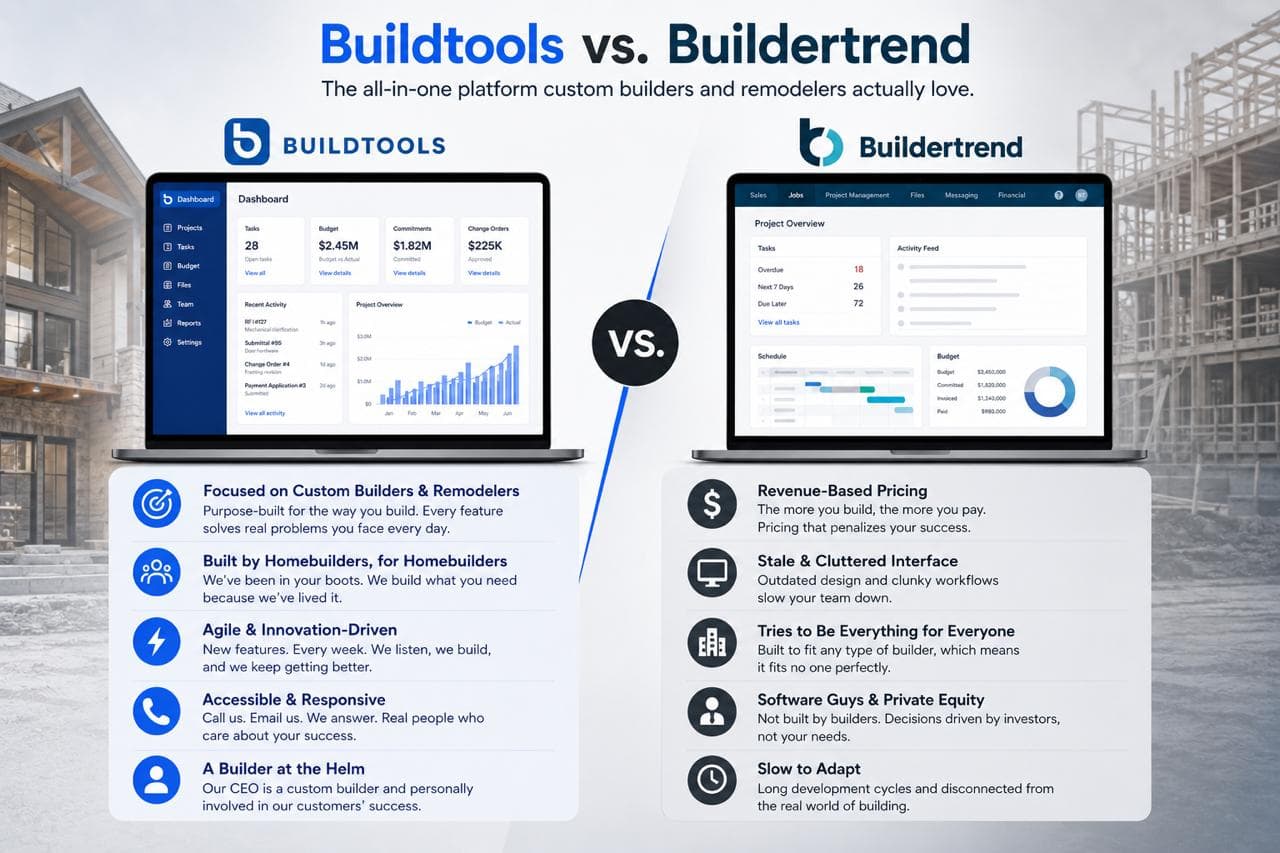
If you're comparing Buildertrend and BuildTools, you've already accepted that your business needs construction management software. The harder question is the one nobody in this category wants to ask out loud:
Is the platform you're about to commit to actually built for how construction will run in 2026 and beyond — or is it a 2015 platform with AI bolted on the side?
That's the comparison that matters.
The short version
Buildertrend is the largest, most established residential construction platform in the market. It has scale, a deep feature catalog, and a polished sales operation. If your priority is buying from the biggest vendor in the space, it's a defensible choice.
BuildTools is something different. It's a construction management platform rebuilt from the ground up on a modern stack, with AI embedded throughout — not as a feature, as the architecture. Voice-driven project management. AI-assisted walkthroughs. AI invoice processing into QuickBooks. AI bid review against specs and selections. AI-generated budgets, specifications, and schedules.
It's built by builders who have run construction companies, sold a SaaS platform to private equity, watched what happened to it, and bought it back to do it right.
If you want a Buildertrend alternative that treats AI as the operating layer — not a marketing checkbox — BuildTools is the one to evaluate.
The category is shifting under everyone's feet
Walk through the Buildertrend feature list, the BuildBook feature list, the JobTread feature list, the Houzz Pro feature list. You'll notice something: they're all selling roughly the same modules that residential construction software has sold for fifteen years. Scheduling. Change orders. Selections. Daily logs. Client portal. Job costing.
AI shows up in most of these platforms as a small bullet — "AI-powered progress updates," or a writing assistant for client messages. It's a feature inside the old platform.
That's the gap.
The next generation of construction management software isn't going to be defined by which platform has the most modules. It's going to be defined by which platform assumes an AI agent is part of the team — capturing notes on the walkthrough, drafting change orders from a phone conversation, reviewing bids against specifications, processing invoices and pushing them to QuickBooks, surfacing budget variances before they show up in your monthly close.
That's the platform BuildTools is building. From scratch. On a modern, open stack.
What "AI-first" actually means in BuildTools
This is where the comparison gets specific.
Virtual Project Management. Talk to BuildTools the same way you'd talk to a project coordinator. "Create a punch item on the Gillis project for the painter to touch up the trim in the master bedroom. Assign it to Mike. Due Friday." It's done. No clicks, no menus.
AI Walkthrough Assistant. Walk a job, talk through what you see, and BuildTools captures notes, generates tasks, builds the punch list, and assembles a client-ready report — all from the audio. The thing every builder already does on a phone, structured and saved.
AI Invoice Processing. Vendor invoices come in, BuildTools reads them, matches them against purchase orders and budgets, flags discrepancies, routes them for approval, and pushes the approved ones into QuickBooks. The hours your bookkeeper spends matching POs disappear.
AI Bid Review. Drop in three subcontractor bids and BuildTools verifies they actually match the specs and selections, highlights scope gaps, and shows you which bid is genuinely apples-to-apples. The hidden cost overruns that come from comparing incomplete bids — gone.
BuildTools Intelligence. Generate budgets, specifications, and schedules with AI assistance trained on how custom builders actually work. Not generic LLM output — construction-specific structure that your project managers will recognize.
None of this is roadmap. It's the platform.
Built by builders — and that means something specific here
"Built by builders, for builders" gets used loosely in this category. In BuildTools' case, it has a specific meaning.
BuildTools was originally founded by Sven Gustafson, a fourth-generation custom home builder running Stonewood (founded 1947). He built BuildTools the first time because the software his company needed didn't exist. After several years under outside ownership, he bought it back to rebuild the platform around what modern builders need now: AI-native workflows, cleaner financial control, and software shaped by the realities of custom residential construction.
The rebuild isn't a refresh. It's a ground-up reimagining of construction management with AI as the foundation, not an add-on. That matters because builder-led product instinct asks different questions than enterprise product instinct does:
- Will the superintendent actually use this on a phone with one hand?
- Does this help accounting, or does it create another cleanup job at month-end?
- Does the project manager see the truth quickly, without a dashboard tour?
- Does this protect margin before the damage shows up in QuickBooks?
- Does the client get clarity without being exposed to internal chaos?
Those are the questions that drive what gets built and what doesn't.
A modern, open stack
The other thing that separates BuildTools from the legacy players: it's built on a modern, open architecture with APIs at the core.
Construction software shouldn't be a walled garden. Your accounting system, your CRM, your estimating tools, your plan review software, your AI agents, your dashboards — they all need to talk to each other. The best builders have unique processes, and they shouldn't be forced into a vendor's rigid template because the underlying platform was built before APIs were table stakes.
BuildTools is being built so your data is yours, your workflows are flexible, and integration is the default — not a professional services engagement.
Buildertrend vs. BuildTools: where each fits
Buildertrend may be the right fit if:
- You want the largest, most established residential vendor
- You prefer a mature feature catalog over a modern architecture
- AI as a small feature inside a traditional platform is what you're looking for
- Vendor scale and brand recognition are your top priorities
BuildTools is the better fit if:
- You want AI built into the foundation of the platform, not bolted on
- You believe voice-driven project management, AI walkthroughs, and AI invoice processing are how construction software should work going forward
- You want a builder-led product team that ships against builder problems, not enterprise dashboards
- You want a modern, open stack with real APIs and clean QuickBooks integration
- You'd rather work with founders than account managers
The verdict
Buildertrend is a serious platform with real strengths. It deserves to be on the evaluation list.
But for custom home builders and remodelers looking at what their operating system is going to be for the next decade — not the last one — the question isn't which vendor is biggest. It's which platform is built for what's coming.
That's BuildTools.
If you want to see what AI-first construction management actually looks like in practice, that's the demo to book.